Energy Poverty and Energy Justice
Who goes without affordable energy, how to measure it, and what the research says about the programs meant to help.
- Completed
- 2020–2023
- Energy justice
- Energy poverty
- Energy policy
- Buildings
In plain English
Energy poverty means being unable to afford the energy a household needs for heating, cooling, light and cooking. In the United States it falls hardest on low-income households, which spend a far larger share of their income on energy than others do. The question running through this work was practical: how to identify households in energy poverty, and which policies and programs actually reach them.
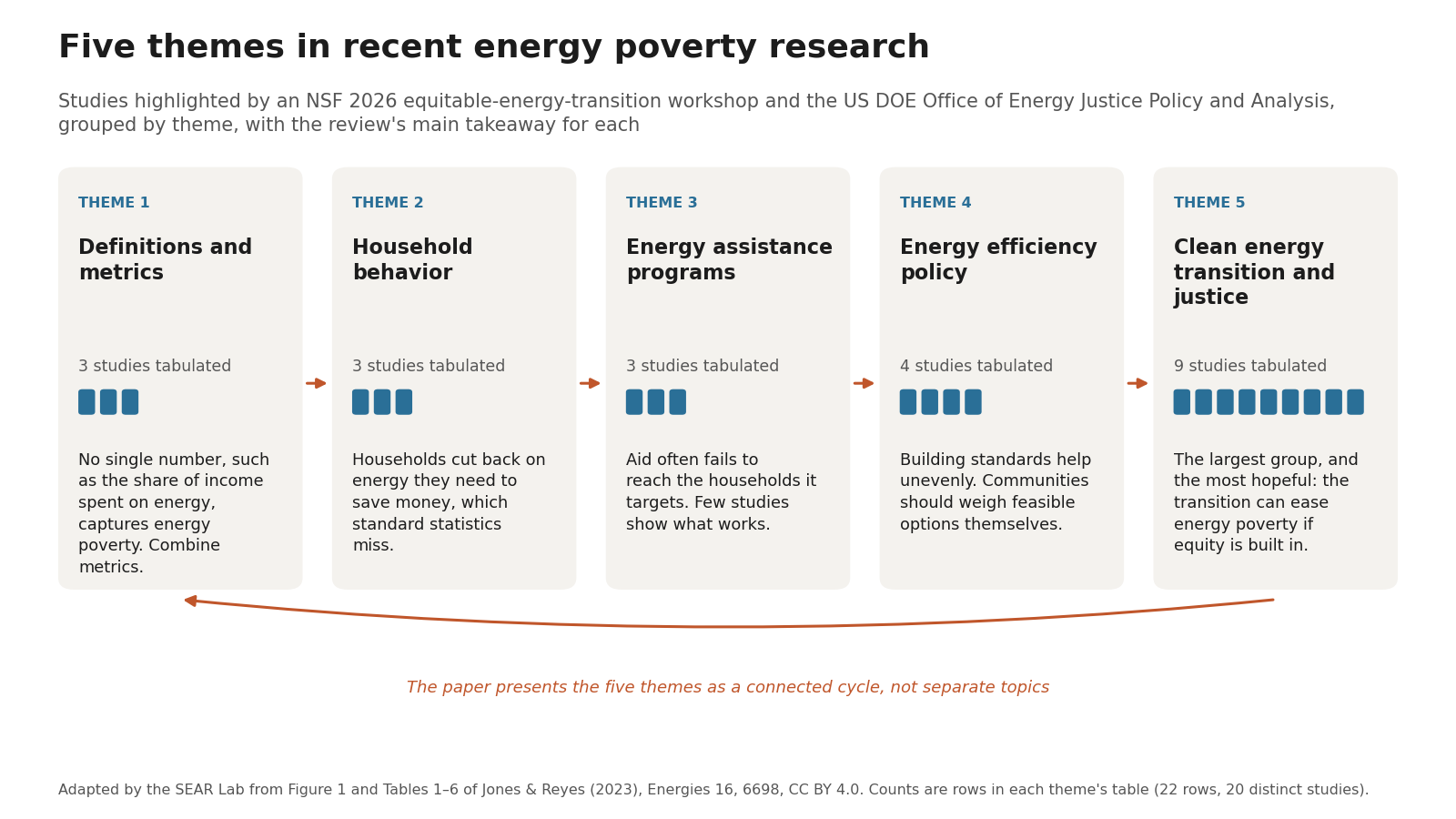
The line grew out of Dr. Jones's earlier Texas work: a 2020 study of how rooftop solar, efficiency upgrades and other distributed energy resources could lower energy burdens in Harris County, reports on how low-income Texans lived through Winter Storm Uri in 2021, and a 2021 white paper on differences among lower-income energy consumers. In 2022 the lab sketched ways to identify energy poverty directly, and that thinking fed a literature review, published in Energies in 2023, that sorts leading energy justice research into five themes and points out where the evidence is thin.
Main points
- Asked two linked questions: how to recognize a household in energy poverty, and which programs actually reach it.
- Looked at distributed energy resources, from rooftop solar to efficiency upgrades, as a way to cut energy burdens in Harris County, Texas.
- Published a review in Energies (2023) that groups leading energy justice studies into five connected themes and flags missing evidence on what works.
- Complete: the review analyzed published studies only, so it produced no new data or code.
Papers
What energy poverty research says, and what it is missing
Jones, E.C., Jr., & Reyes, A. (2023). Identifying themes in energy poverty research: Energy justice implications for policy, programs, and the clean energy transition. Energies, 16(18), 6698. https://doi.org/10.3390/en16186698
What do leading energy justice researchers study? Five themes emerge, with optimism about clean energy but little evidence on which programs work.
- Measuring energy poverty well takes more than standard statistics such as energy burden (the share of income spent on energy); it needs context on how households use, and limit, their energy.
- Households respond to high bills by going without energy they need, and how stakeholders define energy poverty shapes how they act on it.
- Assistance and efficiency programs often fail to reach the most vulnerable households, and research on programs that succeeded, and how to replicate them, is largely missing.
- The clean energy transition was the largest theme, and its researchers were broadly optimistic that it can ease energy poverty, but only if policymakers build equity in explicitly.
Pathways for DERs to reduce energy burdens in Harris County
Harmon, D., Jones, E.C., Jr., Wolfe, E., & Moss, J. (2020). Pathways for DERs to reduce energy burdens in Harris County. ACEEE Summer Study on Energy Efficiency in Buildings.
How lower-income energy consumers differ by race
Jones, E.C., Jr. (2021). Racial disparities among lower-income energy consumers [White paper]. Smart Energy Consumer Collaborative. https://smartenergycc.org/racial-disparities-among-lower-income-energy-consumers-white-paper/
A white paper comparing the energy habits, concerns and finances of lower-income White, Black and people-of-color consumers during the COVID-19 pandemic.
- Lower-income Black and people-of-color consumers often faced greater financial and household strain, yet were more concerned about climate change and more interested in smart energy technologies such as community solar and smart thermostats.
How Winter Storm Uri hit lower-income Texans
Harmon, D., Kemabonta, T., Moss, J., Jones, E.C., Jr., & Robison, A. (2021). When the Lone Star froze over: Winter Storm Uri and the lived experiences of Texas low-income communities [Report]. Texas Energy Poverty Research Institute (TEPRI). https://tepri.org/2021/07/when-the-lone-star-froze-over-winter-storm-uri-and-the-lived-experiences-of-texas-low-income-communities/
A report splitting a statewide survey by income to show how the February 2021 storm fell hardest on households already struggling with energy bills.
- Draws on TEPRI's survey of 953 Texans (March 8–10, 2021), split into lower-income and higher-income households.
- Before the storm, about 77% of lower-income respondents were concerned about affording their electricity bills, against 40% of higher-income respondents.
- About one in three lower-income respondents (34%) already had overdue electricity bills before the storm, against 13% of higher-income respondents.
First results from a statewide survey after Winter Storm Uri
Jones, E.C., Jr., Moss, J., & Kemabonta, T. (2021). Lived experiences of Winter Storm Uri [Blog post]. Texas Energy Poverty Research Institute (TEPRI). https://tepri.org/2021/03/blog-lived-experiences-of-winter-storm-uri/
A blog post on early survey results: most Texans lost power, many for days, and the storm left lasting worry about bills.
- TEPRI surveyed 953 Texans across city, suburban, town and rural areas on March 8–10, 2021.
- Almost 75% of respondents lost electricity during the storm, and close to a third lost it for two days or more.
- Just over 25% lost natural gas, but gas furnaces still need electricity to run, so many households had no heat either way.
- The storm raised stress about paying electricity bills and uncertainty about where to get help.
What heat pumps could do for Houston homes
Jones, E.C., Jr., Harmon, D., & Kemabonta, T. (2021). Energy and emissions savings potential of renewable thermal technologies in Houston, Texas [Report]. Renewable Thermal Alliance, Yale Center for Business and the Environment. https://cbey.yale.edu/research/energy-and-emissions-savings-potential-of-renewable-thermal-technologies-in-houston-texas
Replacing gas and resistance heating with heat pumps could cut Houston's residential energy use and emissions roughly in half.
- Heat pumps could reduce total residential energy use by up to 54% and residential emissions by up to 53%, and virtually eliminate residential natural gas use.
- Even with the added electric heating load, residential electricity use falls by up to 38%, cutting the solar needed to decarbonize it by the same share.
- Existing energy-efficiency programs, plus outreach to households and training for contractors, are the suggested route to wider adoption.
Community solar that works in Texas's competitive market
Kemabonta, T., Jones, E.C., Jr., Harmon, D., & Pittman, J. (2021). A new approach to developing community solar projects for LMI communities in ERCOT's competitive electricity markets. 2021 IEEE Global Humanitarian Technology Conference (GHTC), 86–93. https://doi.org/10.1109/GHTC53159.2021.9612482
Community solar usually lowers bills for lower-income households, but Texas's deregulated market makes it hard to build; this paper proposes a model designed for ERCOT.
- Explains why community solar, common elsewhere for cutting lower-income households' bills, is hard to deploy in Texas's competitive ERCOT market.
- Notes the scale of the problem: 3.7 million Texas households live below 80% of area median income, and an energy burden above 6% of income is considered high (above 10%, severe).
- Proposes the LMI Community Impact Solar model: a medium or large power user hosts the solar behind its meter and uses it to cut summer demand charges, while an 'energy dividend' (bill credits or cash) goes to lower-income households.
- The model avoids the cost of interconnecting distributed generation under PUCT and ERCOT rules, and the authors argue it could be used in other electricity markets too.
People
- Erick C. Jones Jr., PhD, PEPrincipal Investigator · SEAR Lab directorin
- Ariadna ReyesAuthor, Energies 2023
Profiles marked in link to LinkedIn. More past and present lab members are on the SEAR Lab team page.