Battery Recycling and Black Mass
Making lithium-ion battery recycling cheaper and more local, from grinding old cells into black mass to recovering the metals.
- Active
- 2024–present
- Battery recycling
- Circular economy
- Critical minerals
- Reverse logistics
In plain English
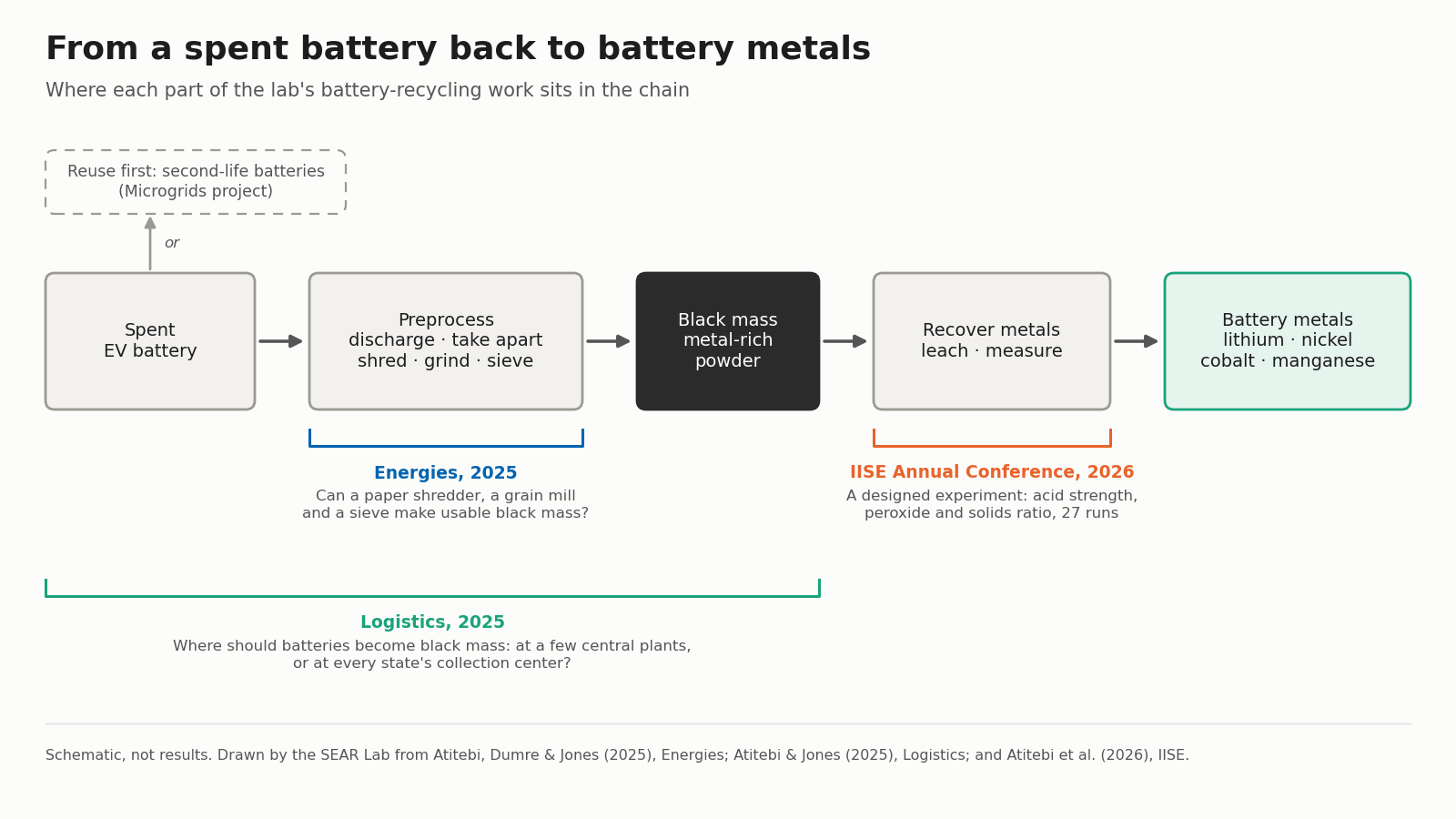
Recycling lithium-ion batteries could ease the need for new mines, but the first step is slow and costly. Spent batteries must be discharged, taken apart and ground into black mass, a dark powder rich in lithium, nickel, cobalt and manganese, before any metal can be recovered. Today that mostly happens at a few large plants, so bulky batteries travel long distances as hazardous freight.
Oluwatosin Atitebi's work asks whether this step can move closer to where batteries are collected. It began at the bench: a 2025 Energies paper showed that inexpensive, off-the-shelf equipment could turn an old electric-vehicle battery module into usable black mass. A second 2025 paper, in Logistics, scaled the idea up to a model of a U.S. recycling network, comparing black mass made at a few central plants with black mass made at every state's collection center. The current step, reported at the 2026 IISE Annual Conference, designs chemical extraction experiments to recover the metals from that black mass.
Main points
- Follows one chain end to end: grinding spent batteries, deciding where that should happen, and recovering the metals.
- Pairs bench experiments with network optimization, so equipment tested in the lab informs the cost model of a national network.
- Builds on the lab's second-life battery work: reuse comes first, and recycling follows when a battery can no longer serve.
- Now running designed leaching experiments that vary acid strength, an oxidizing agent and the ratio of black mass to liquid.
Interactive demoBattery recycling →
Papers
Under $1,000 of equipment turns an old EV battery into black mass
Atitebi, O.S., Dumre, K., & Jones, E.C., Jr. (2025). Supporting a lithium circular economy via reverse logistics: Improving the preprocessing stage of the lithium-ion battery recycling supply chain. Energies, 18, 651. https://doi.org/10.3390/en18030651
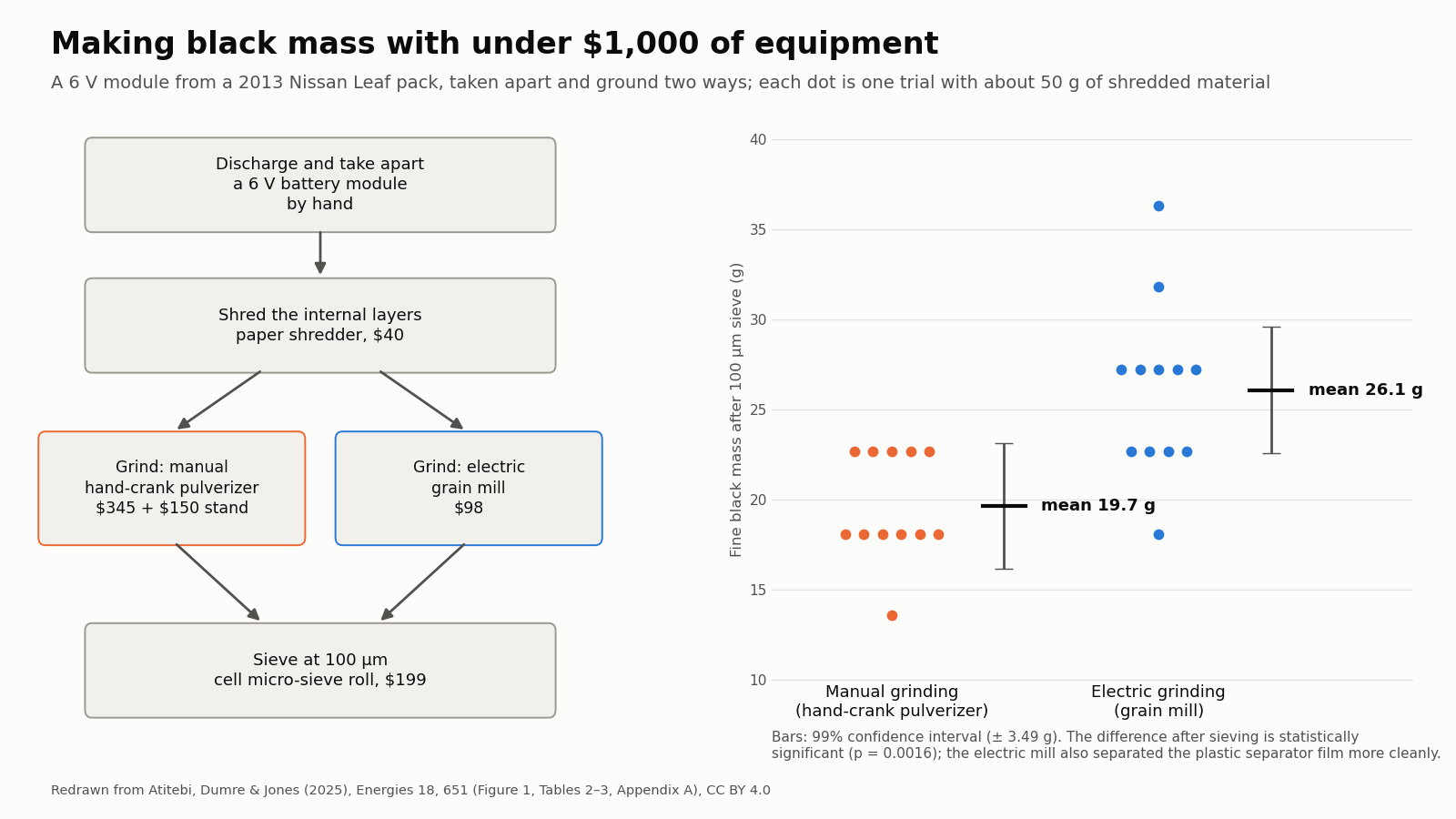
With a $40 shredder, a $98 electric grain mill and a sieve, the team turned an old Nissan Leaf battery into usable black mass.
- After sieving, electric grinding gave 26.1 g of fine black mass per 50 g sample on average, against 19.7 g for hand grinding, a statistically significant difference (p = 0.0016).
- About 54% of the electrically ground material passed the 100-micrometer sieve, compared with about 44% for hand grinding.
- The whole setup (a paper shredder, a hand-crank pulverizer, a grain mill and a sieve roll) cost about $800, orders of magnitude less than commercial equipment.
- Electrically ground black mass had visibly finer particles under the microscope and almost no separator film, which should make the later chemical recovery of lithium easier.
Making black mass locally could cut battery recycling costs by 42%
Atitebi, O.S., & Jones, E.C., Jr. (2025). Centralized vs. decentralized black-mass production: A comparative analysis of lithium reverse logistics supply chain networks. Logistics, 9(3), 97. https://doi.org/10.3390/logistics9030097
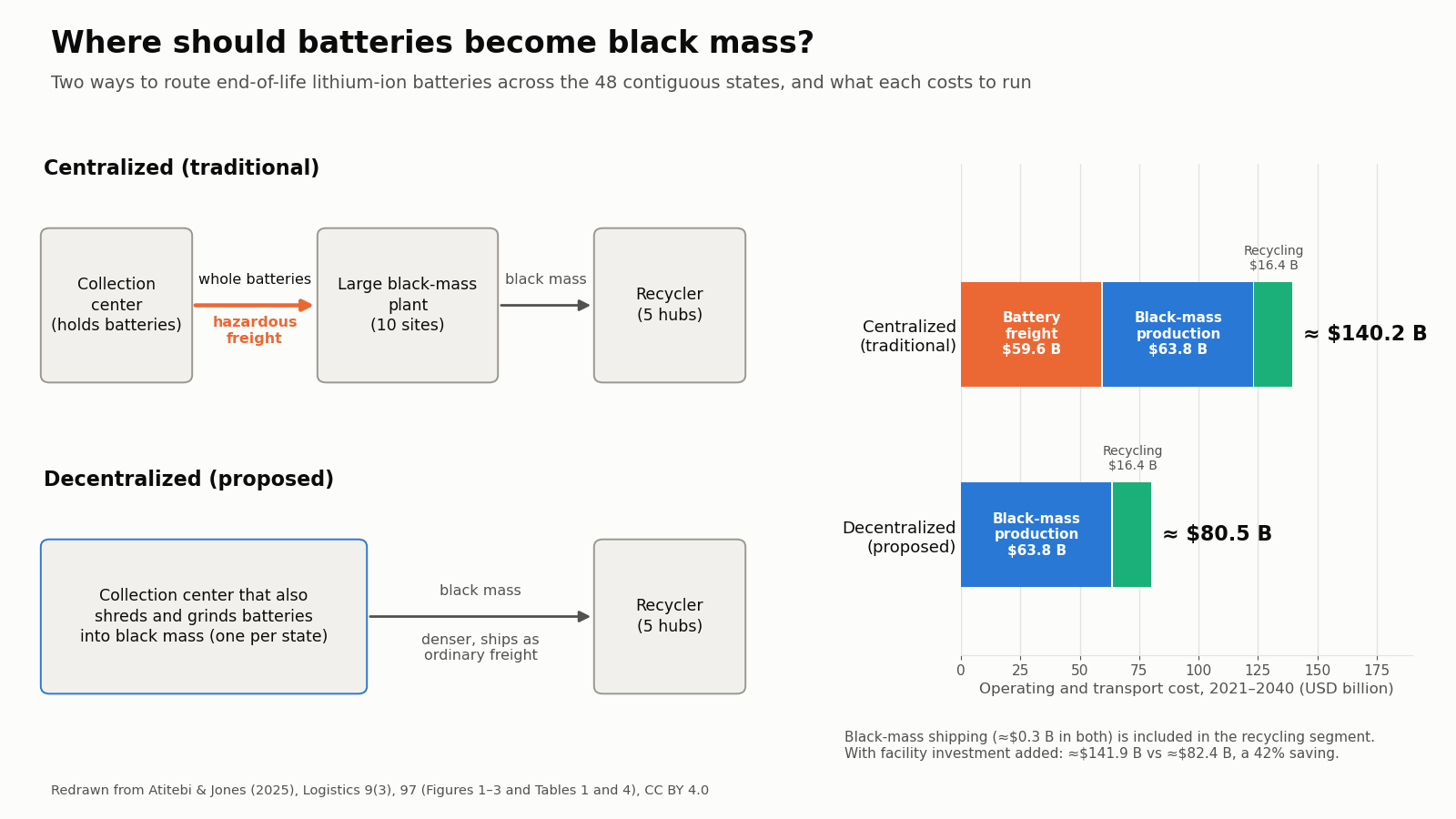
Grinding spent batteries into black mass at local collection centers, instead of shipping them whole, cut a modeled U.S. recycling network's cost by 42%.
- Over 2021–2040, the decentralized network's total cost was about $82.4 billion, against $141.9 billion for the traditional centralized network, a 42% reduction.
- Moving whole batteries to black-mass plants cost $59.6 billion in the centralized model, and the decentralized design removes that step entirely.
- Because it needs many small facilities, the decentralized network costs about 7% more to build ($1.82 billion vs. $1.70 billion), which is small next to the freight savings.
- Emissions were similar, about 20.7 versus 21.2 million tonnes of CO2-equivalent, because both networks process the same amount of material.
Planning the experiments that pull metals back out of black mass
Atitebi, O.S., Dumre, K., Shelor, C.P., & Jones, E.C., Jr. (2026). Experimental design for optimized recovery of critical minerals from lithium-ion battery black mass: Bridging sustainability and process efficiency. Proceedings of the IISE Annual Conference & Expo 2026.
A designed experiment, three factors at three levels, guides chemical leaching trials on black mass made with the lab's low-cost grinding process.
A framework for getting the most value out of used batteries
Jones, E.C., Jr. (2026). 3R-BET: Remanufacturing, repurposing, and recycling battery and energy technologies. Proceedings of the IISE Annual Conference & Expo 2026.
Before a battery is recycled for its metals, it may be repaired, repurposed or remanufactured: a staged testbed for doing that economically.
- Proposes a research framework and testbed for recovering value from end-of-life batteries and energy technologies, in five stages: collection, disassembly and characterization; repurposing; recovering intermediate materials; remanufacturing with them; and raw-material recovery.
- Orders the options from most to least value kept: repair and refurbishment first, then repurposing, remanufacturing and, last, recycling.
- Places each stage in the wider supply chain to show where value can be added, and where the risks lie.
- The lab has applied the framework to used electric-vehicle battery packs, taking material through collection, disassembly, characterization, repurposing and recycling.
Turning recycled battery graphite into 3D-printing powder
Yang, E., Atitebi, O.S., Shelor, C.P., & Jones, E.C., Jr. (2026). Upcycling graphite from spent Li-ion batteries into graphite–Nylon 12 composite for powder bed fusion additive manufacturing. Proceedings of the IISE Annual Conference & Expo 2026.
Graphite recovered from spent lithium-ion batteries has particles in the right size range to fill nylon powders for powder bed fusion printing.
- Compared commercial graphite powder with graphite-rich black mass recovered from spent lithium-ion batteries, by particle shape and size.
- The black mass has a broader spread of particle sizes and more clumping than commercial graphite, but after delithiation its particle sizes fall in the same practical range.
- In Nylon 12 powders made with commercial graphite, more graphite meant more surface coverage and more clumping, and wet mixing spread the graphite more evenly than dry mixing.
- All the composite powders stayed in a size range suitable for spreading in powder bed fusion, giving a baseline for replacing commercial graphite with recycled graphite next.
Code and materials
People
- Erick C. Jones Jr., PhD, PEPrincipal Investigator · SEAR Lab directorin
- Oluwatosin S. AtitebiAuthor, Energies 2025 · Author, Proceedings of the IISE Annual Conference & Expo 2026 2026
- Kalpana DumreAuthor, Energies 2025 · Author, Proceedings of the IISE Annual Conference & Expo 2026 2026
- Charles P. ShelorAuthor, Proceedings of the IISE Annual Conference & Expo 2026 2026
- E. YangAuthor, Proceedings of the IISE Annual Conference & Expo 2026 2026
Current team: names to be added from the lab personnel sheet. Profiles marked in link to LinkedIn. More past and present lab members are on the SEAR Lab team page.